
Human in the loop (HITL) is a design pattern that requires a human to approve or correct specific AI decisions before they take effect. If you are using AI in a classroom, a personal project, or any high-stakes context, add a human checkpoint now for any action that is irreversible, affects another person, or involves low AI confidence. Stanford HAI frames this as the essential shift away from full autonomy toward human-led accountability. The EU AI Act's Article 14 mandates human oversight for high-risk AI systems, and Thinksmarterai builds every exercise around this same principle.
Table of Contents
- What human in the loop actually means, and why it matters
- Core design principles and the five patterns that actually work
- A step-by-step HITL workflow you can start today
- How to measure reliability and decide when to reduce oversight
- Ethics, privacy, and U.S.-specific guidance for educators
- Classroom exercises and reviewer checklists you can use now
- Key Takeaways
- Why keeping humans in the loop is the whole point
- Thinksmarterai resources to practice what you just learned
- Useful sources
What human in the loop actually means, and why it matters
HITL is the practice of placing a human decision point inside an AI workflow, not just watching from the outside. IBM defines it as human participation in operation, supervision, or decision-making to ensure accuracy, safety, and ethical outcomes. The contrast matters: human-on-the-loop means a person can intervene but does not have to; human-out-of-the-loop means the system acts entirely on its own.

Human judgment handles what algorithms cannot: edge cases, ethical nuance, and accountability. A medical diagnosis tool that flags uncertain results for a clinician is safer than one that always commits to an answer. Content moderation that routes borderline posts to a trained reviewer is fairer than a model acting alone. In education, a teacher who reviews AI-generated feedback before a student sees it protects both accuracy and trust.
Where HITL is most valuable: high-stakes decisions (medical, legal, financial), regulated environments, ambiguous or novel inputs, and any action that cannot be undone. Where it is not worth the overhead: high-volume, low-risk, well-tested tasks such as spam filtering on a mature system or auto-formatting documents.
The industry is shifting away from full unmonitored autonomy. HITL preserves human accountability and is essential in clinical and other high-stakes fields. — Stanford HAI
Core design principles and the five patterns that actually work
Three principles anchor every effective HITL system.
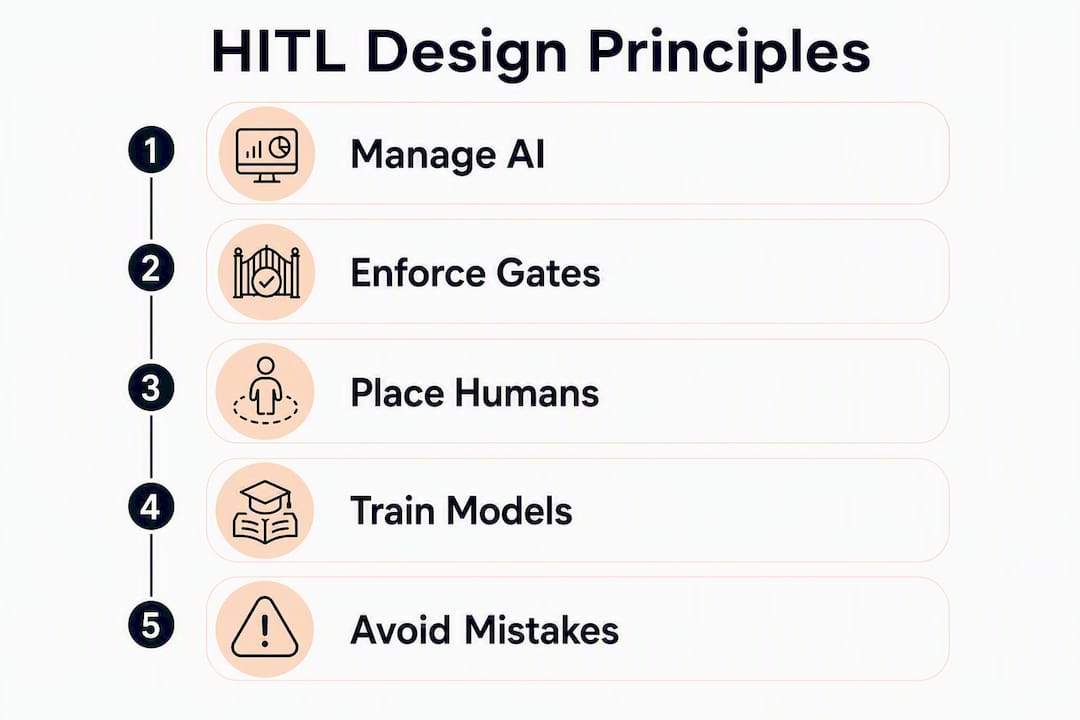
Manage AI confidence. IBM notes that the primary goal is to make systems escalate rather than guess when uncertain. Set a confidence threshold; anything below it routes to a human.
Enforce architectural gates. Cordum's production practitioners are direct: a prompt instruction telling the AI to "ask before acting" is not real HITL. A model can ignore or hallucinate past a prompt. Real enforcement requires a dispatcher and policy engine that blocks execution until a human approves.
Match oversight to risk. Routing every output to a human reviewer creates fatigue and rubber-stamping. Assistents.ai warns that adding humans everywhere causes automation bias, where reviewers stop reading carefully because they approve almost everything.
The five production patterns Cordum recommends are:
- Pre-execution gate — human approves before the AI acts (highest safety, highest latency).
- Exception escalation — AI handles routine cases; uncertain or flagged ones go to a human.
- Graduated autonomy — AI earns more independence as it proves reliability on a task.
- Sampled audit — a random or risk-weighted percentage of outputs gets human review.
- Post-execution review — human reviews after the fact, primarily to catch drift and retrain.
Common mistakes: treating a chatbot prompt as an enforcement mechanism, routing every output to the same reviewer regardless of expertise, and never updating thresholds as the model improves.
Pro Tip: Place your first human checkpoint at the highest-risk, lowest-volume step. That is where a mistake costs the most and where a reviewer's time is best spent.
A step-by-step HITL workflow you can start today
This workflow fits personal projects and classroom settings equally well.
- Define risk level. Categorize each AI task: high (irreversible, affects others), medium (reversible but consequential), or low (easily corrected, low stakes).
- Set confidence thresholds. Decide the score below which the AI must escalate. Start conservatively.
- Route to the right reviewer. Match the decision to someone with relevant expertise, not just whoever is available.
- Surface context for the reviewer. Show the confidence score, the input data used, and the AI's reasoning. Databricks confirms that this context transforms reviewers from bottlenecks into effective safeguards.
- Require a decision, not just a click. Ask the reviewer to approve, reject, or edit, and log which they chose and why.
- Record every decision. Build an audit trail. Feed corrections back to improve the model over time.
Sample confidence threshold table
| Task | Suggested threshold for human review | Risk level |
|---|---|---|
| Student essay feedback | Below 70% confidence | Medium |
| Flagging inappropriate content | Below 85% confidence | High |
| Auto-grading multiple choice | Below 90% confidence | Medium |
| Summarizing a reading passage | Below 70% confidence | Low |
| Medical or legal information | Any output | High |
Classroom-friendly variants
- Elementary (low-stakes writing feedback): Teacher reviews all AI suggestions before sharing with students. Students see only approved comments.
- Middle school (project approvals): AI drafts a rubric score; teacher confirms or adjusts before returning it.
- High school (research assistance): Students submit AI-generated outlines; a peer reviewer and teacher both check for accuracy before the student proceeds.
What a reviewer sees in a well-designed approval gate: the AI's output, a confidence score (e.g., 73%), the source data the model used, and a short rationale. The reviewer then clicks Approve, Edit, or Reject, and the system logs the choice with a timestamp.
How to measure reliability and decide when to reduce oversight
Tracking the right metrics tells you when your HITL setup is working and when you can safely loosen it.
- Error rate: percentage of AI outputs that required correction after review.
- Override rate: how often reviewers change the AI's recommendation.
- Reviewer agreement: do two independent reviewers reach the same decision? Low agreement signals unclear criteria or reviewer training gaps.
- Time-to-approval: how long decisions sit in the queue. Long queues mean the threshold is too low or routing is wrong.
- False positive/negative rate: for classification tasks, track both directions.
Decision criteria for graduated autonomy
| Metric | Threshold to reduce oversight | Action |
|---|---|---|
| Error rate | Below 2% over 30 days | Move from pre-execution gate to exception escalation |
| Override rate | Below 5% over 30 days | Reduce sampled audit frequency |
| Reviewer agreement | Above 85% | Simplify reviewer criteria; consider automation |
| Time-to-approval | Under 4 hours consistently | Current routing is working; hold thresholds |
IBM notes that human corrections fed back into training reduce model drift and improve alignment over time. Run a retraining cycle whenever your error rate climbs or your override rate spikes.
Ethics, privacy, and U.S.-specific guidance for educators
Two federal laws shape how educators in the U.S. must handle student data inside any AI workflow.
FERPA (Family Educational Rights and Privacy Act) restricts disclosure of student education records. Any AI tool that processes identifiable student work requires a data-sharing agreement, and reviewers should see only the minimum data needed to make a decision.
COPPA (Children's Online Privacy Protection Act) applies to children under 13. Do not route identifiable data from students under 13 through any AI system without verified parental consent and a compliant data processor.
Practical safeguards:
- Anonymize student work before it enters any AI pipeline where possible.
- Use role-based access so reviewers see only what their role requires.
- Maintain an audit trail of every human decision involving student data.
- Train reviewers on bias: a reviewer's own assumptions can introduce the same problems HITL is meant to prevent.
For primary sources, consult the U.S. Department of Education's FERPA guidance and the FTC's COPPA resources directly. This article is general information, not legal advice; confirm current requirements with a qualified professional for your specific situation.
Classroom exercises and reviewer checklists you can use now
Three ready-to-use exercises
-
Elementary: "Is the AI right?" (grades 3–5, 20 minutes). Give students a short AI-generated paragraph about a topic they know well (their school, their town). Students circle anything that seems wrong or odd, then discuss as a class. Goal: build the habit of checking AI output rather than accepting it.
-
Middle school: The approval gate (grades 6–8, 30 minutes). Students use an AI tool to draft a summary of a chapter. A partner acts as the human reviewer using the checklist below. Goal: practice structured review and understand why a second set of eyes matters.
-
High school: Graduated autonomy simulation (grades 9–12, 45 minutes). Students run three rounds of an AI-assisted research task. In round one, every output requires human approval. In round two, only low-confidence outputs do. In round three, students decide which outputs still need review. Goal: understand how trust in a system is earned through evidence, not assumption.
Reviewer checklist
- Is the AI's output factually accurate based on what you know or can quickly verify?
- Does it contain any biased, harmful, or inappropriate language?
- Is the confidence score consistent with the output quality you see?
- Would you be comfortable if a student or parent saw this output as-is?
- If you are editing: does your edit fix the problem without introducing a new one?
For adult learners or self-study: run the middle school exercise alone, acting as both the AI user and the reviewer. The Thinking Check tool on Thinksmarterai gives you a structured prompt to evaluate any AI output against these criteria.
Key Takeaways
Human in the loop works because it places human judgment exactly where AI confidence is lowest and stakes are highest, making oversight targeted rather than exhausting.
| Point | Details |
|---|---|
| Add a checkpoint at high-risk steps | Any irreversible, high-stakes, or low-confidence AI action needs a human approval gate before it executes. |
| Enforce architecture, not just prompts | A policy engine that blocks execution is real HITL; a prompt asking the AI to "check first" is not. |
| Surface context for reviewers | Show confidence scores, input data, and AI reasoning so reviewers make informed decisions quickly. |
| Measure override and error rates | Track these monthly; when error rate drops below 2% and override rate below 5%, consider graduated autonomy. |
| Thinksmarterai resources | The Young Thinkers Roadmap and Thinking Check tool give educators and learners ready-to-use HITL exercises. |
Why keeping humans in the loop is the whole point
The conventional wisdom treats HITL as a temporary fix, something you do until AI gets good enough to go solo. That framing is wrong, and the evidence from Stanford HAI and production practitioners makes it clear why. Accountability cannot be automated. When an AI system makes a consequential decision, someone has to own it, and that someone needs to have been genuinely in the loop, not just technically available to intervene.
What most guides underestimate is the reviewer side of this equation. A human who sees a queue of 200 AI outputs and clicks through them in 20 minutes is not a safeguard. Effective HITL requires trained reviewers, targeted routing, and interfaces that surface the right context. The architecture matters as much as the intention.
Thinksmarterai centers every resource on this reality. The how we work with AI page shows what human oversight looks like in practice, not in theory. The exercises in this guide are built on the same principle: AI is a tool, human judgment is the point.
Thinksmarterai resources to practice what you just learned
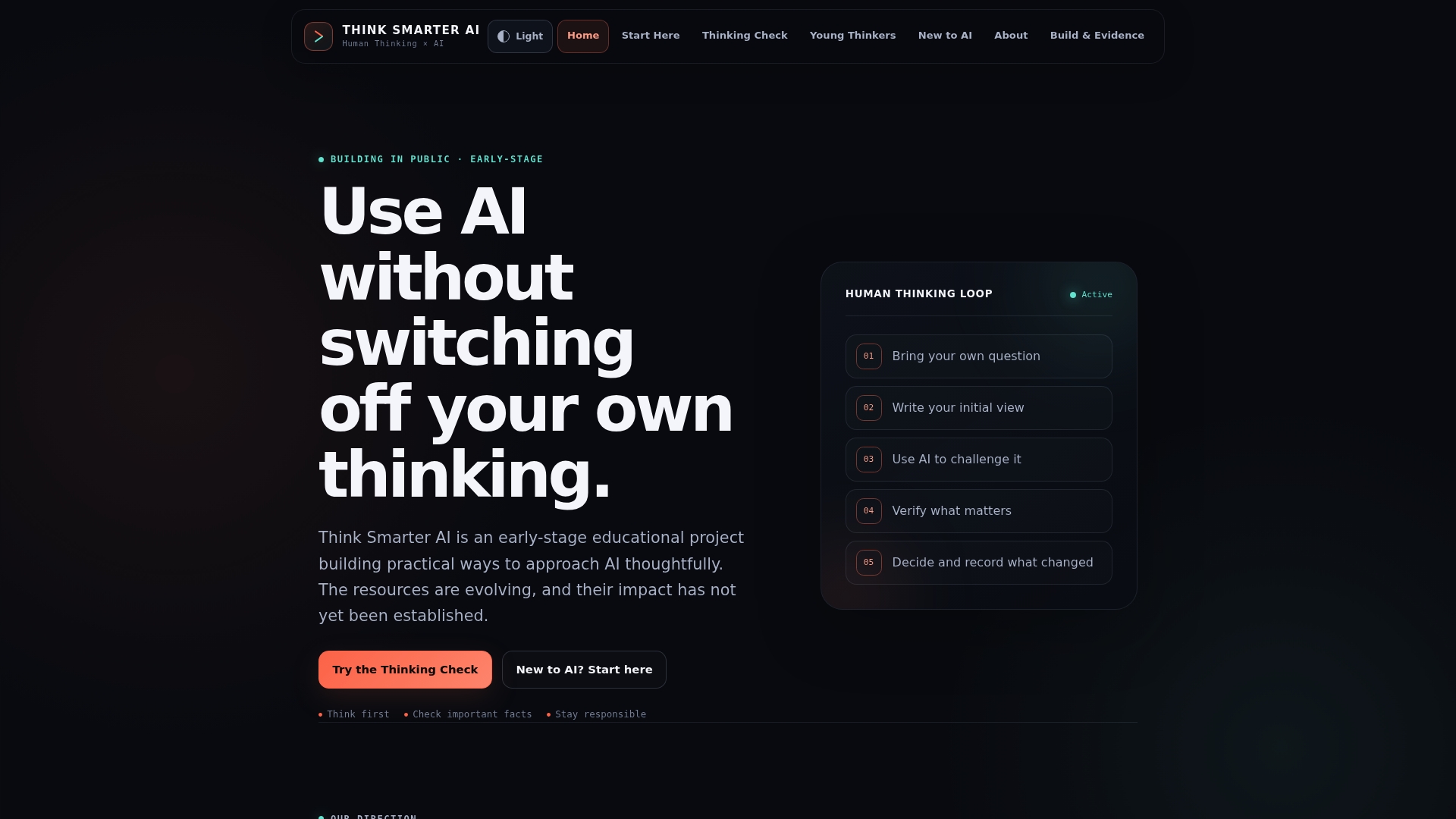
The exercises in this guide work best when you have a structured place to practice them. Thinksmarterai's New to AI beginner resource walks first-time users through exactly how to engage AI as a thinking partner rather than an answer machine, with guided activities you can complete in under 30 minutes. For educators working with younger students, the Young Thinkers Roadmap provides age-appropriate exercises and a curriculum-ready sequence that maps directly to the classroom variants in this guide. Start with the Thinking Check tool to evaluate your first AI output using the reviewer checklist above, then move into the beginner guide when you are ready to go deeper.
Useful sources
- Stanford HAI: What Is Human In The Loop? — Academic framing of HITL as a human accountability mechanism; the authoritative starting point for understanding why the field is moving away from full autonomy.
- IBM: What Is Human In The Loop? — Practitioner-level definition covering HITL roles across training and production, regulatory links (EU AI Act), and trade-offs including bias mitigation, cost, and latency.
- Databricks: What is Human-in-the-Loop? — Production-focused overview of confidence thresholds, risk scoring, and the HITL vs. human-on-the-loop distinction; strong on reviewer interface design.
- Cordum: Human-in-the-Loop AI: 5 Production Patterns — The clearest practitioner guide on architectural enforcement and the five production patterns; essential reading before implementing any HITL workflow.
- Assistents.ai: What is Human-in-the-Loop? — Practical guidance on reviewer fatigue, cognitive load, and matching human involvement to stakes; useful for educators designing review workflows.
- Zapier: Human in the Loop — Accessible walkthrough of adding checkpoints and feedback loops in common automation tools; good for low-barrier classroom implementation.
- Wikipedia: Human-in-the-loop — Broad definitional overview spanning simulation, autonomous weapons, and machine learning contexts; useful background for understanding the term's range.
- MDPI Entropy: HITL AI Systematic Review — Peer-reviewed systematic review covering HITL taxonomy, scalability challenges, trust calibration, and ethical governance; the most thorough academic source in this list.
- Google Cloud: What is Human-in-the-Loop? — Platform-level explanation of how humans interact with ML systems through labeling, evaluation, active learning, and reinforcement learning.
- U.S. Department of Education: Student Privacy (FERPA) — Primary source for FERPA compliance guidance; consult directly for current requirements before deploying any AI tool that processes student records.